I · Chapter One
What He Brought Home
"She wore it today because Emeka was coming home."
She had taken the afternoon off.
This was the thing Adaeze thought about later — not the moment she saw them, not the roses, not the particular quality of his laugh when he did not know she was watching. She thought about the afternoon off. She had not taken an afternoon off in four months. She had submitted the leave request at seven AM and her manager had approved it in eleven minutes and she had felt something loose in her chest all day, a lightness she kept testing like a loose tooth, the specific pleasure of a day that belonged to something other than work.
She had worn the No.5.
She did not wear it every day. She wore it for important things — the kind of important that required a physical marker, something she could smell on her own wrist and remember what the day was for.
She had worn it on their wedding day, which was nine years ago in December when the harmattan was just starting and the sky was the colour of old brass and Emeka had looked at her across the compound of her parents' house as if she were the solution to a problem he had not known he had. She had worn it the day she got the manager promotion in 2019 and stood in the bathroom of her office and looked at herself in the mirror and said you did this out loud because there was no one else in the room to say it. She had worn it the day she wired the money for his final year fees — the last large transfer, the one that finished what they had started — and sat at her kitchen table afterwards with the transaction receipt printed and folded into the folder she kept in the bottom drawer of her wardrobe and felt the specific pride of someone who has kept a promise to herself.
She wore it today because Emeka was coming home.
Eleven years. She turned the number over on the way to the airport the way you turn something in your hands to find the shape of it. Eleven years of phone calls across time zones, of WhatsApp messages at midnight her time because it was evening his time and he had finished at the hospital and wanted to talk. Eleven years of managing his family's expectations and her own family's questions and the particular silence of a flat that had only ever been occupied by one person even though it was meant for two. Eleven years of being the person who held things together from a distance, who made the calls and sent the money and wrote the letters and maintained the faith of the whole enterprise when faith was the thing in shortest supply.
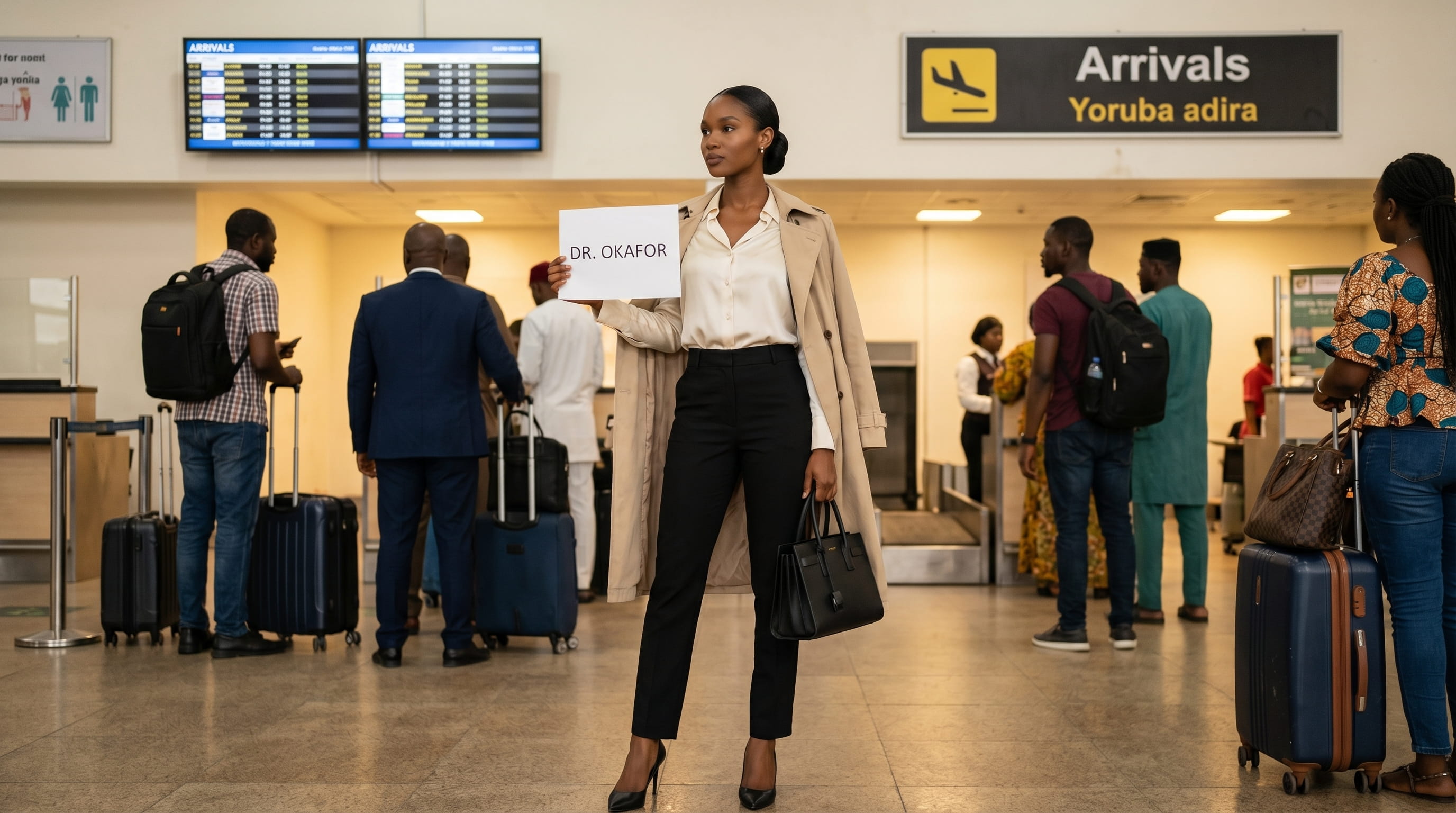
She had a sign.
She had made it the night before, slightly embarrassed by herself, slightly not. White card, black marker, his name in capital letters: DR. OKAFOR. She thought it would make him laugh. She thought the formality of it — the official acknowledgment of everything the eleven years had produced, the title, the achievement, the reason for all of it — would be the right note to strike when he came through those doors. She had practised holding it. She had stood in her living room at ten PM with the sign at chest height and smiled at the wall and told herself not to cry at the airport because her mascara was new.
The arrivals hall at Murtala Muhammed was the way it always was — loud, specific, breathing with its own particular energy that was part reunion and part chaos and entirely Lagos. She found a position near the front of the waiting crowd and settled in. His flight had landed forty minutes ago. She knew because she had tracked it on her phone from the office, had watched the little plane symbol crawl across the map of the Atlantic with a concentration she usually reserved for quarterly figures.
She saw him before he saw her.
He came through the doors with the particular walk of a man who has been travelling for seven hours and is now in a country where the air feels different, where the weight of the place is different, where everything smells and sounds and moves in a way that is not England. He was thinner than she remembered from the video calls — the calls had a way of compressing everything, flattening dimensions she had forgotten bodies had. His carry-on was the same navy blue duffel she had bought him in 2018 from a market in Balogun, haggled down from the second price she was offered by a vendor who had respected the effort. She had paid three thousand naira for it and he had used it for seven years.
He was laughing.
She noticed the laugh before she noticed anything else because it was the laugh she had been missing for eleven years — not the careful, telephone laugh, the real one, the one that happened in his body and came out uncontrolled and made the skin around his eyes do something specific. She had loved that laugh when she was twenty-three years old and meeting him at a friend's party in Ikeja and she had loved it every year since including the years when she did not hear it very often and missed it the way you miss a particular quality of light.
He was laughing at something the woman beside him had said.
The woman beside him.
Adaeze's brain processed this in stages, the way a system processes an instruction it was not designed to receive. A woman. Beside him. Pulling a wheeled case that matched his checked luggage — she could see the tag, the same airline, the same flight. Her hand was not through his arm. She was not touching him at all. They were simply walking beside each other and talking, and he was laughing at something she said.
There were explanations. Adaeze's mind produced them rapidly, obediently, the same mind that had spent eleven years finding the most functional interpretation of available information. A colleague. A fellow doctor from the same hospital. A friend who happened to be on the same flight. Nigeria was not large and medicine was not large and it was entirely possible that two Nigerian doctors at the same London hospital had booked the same flight home.
Then Emeka looked up and found her.
She watched his face.
She had spent nine years married to this man and she knew his face the way you know a landscape — every shift of light on it, every adjustment. She watched him see her. She watched the laugh stop. She watched something move behind his eyes that was not surprise at seeing her but something more complicated, a calculation, a preparation, the specific expression of a person who has been rehearsing a conversation and has just received the signal to begin.
He said something to the woman without looking at her.
The woman glanced across at Adaeze.
The woman's expression did something that was not surprise either.
Adaeze lowered the sign.
She held it at her side. The card was slightly damp from her palm. She watched Emeka come toward her with the roses — she could see them now, the kind sold at airport shops, wrapped in cellophane with a ribbon, the kind purchased in a final-minute decision — and she watched the woman stand at a careful, calculated, previously arranged distance, and she stood in the arrivals hall of Murtala Muhammed airport wearing Chanel No.5 and holding a sign that said DR. OKAFOR and she understood everything she needed to understand.
She had not come to an end. That was the first thing she felt, and she was surprised by it — not devastated, not collapsed, not destroyed the way she had sometimes thought she might be if the fear she had been keeping in a small locked room at the back of herself ever turned out to be justified. She felt very clear.
She felt the way a room feels when someone turns the lights on after a long time in the dark — the same room, exactly, but visible now in a way that changes everything about how you understand it.
Emeka reached her.
He was holding out the roses. He was saying her name — Adaeze — with an inflection she could read precisely, not joyful, not careless, the inflection of a man who needs the next few minutes to go a specific way.
She looked at him. She looked at the roses. She looked at the woman who was examining the middle distance with elaborate concentration.
She took the roses.
“Welcome home,” she said. Her voice came out even. This surprised her faintly. “Give me a moment.”
She walked to a bin near the edge of the waiting area. She stood over it. She considered the roses for a beat — the cellophane, the price sticker she could read now that she was holding them, the seven pounds ninety-nine from the WHSmith in Terminal 5, purchased at what she calculated was approximately the time the plane began its descent. She placed them in the bin. She turned around and walked back.
“We should talk,” she said. “Not here. When we get home. We should talk.”
He nodded. He had the expression of a man who has been preparing for a difficult thing and is relieved that it is beginning because the preparation was its own particular exhaustion.
She looked once at the woman. The woman looked back. In the woman's eyes Adaeze saw something that was not triumph and not cruelty and was, she thought, something closer to guilt — the specific guilt of someone who knows they are part of something larger and more complicated than they fully understand.
Adaeze said nothing to her.
She picked up her car keys and walked toward the exit and Emeka followed and the arrivals hall continued in its particular Lagos way — loud and specific and entirely indifferent — and she walked through it wearing the No.5 she had put on for an important day, and this day was certainly that.
She placed the roses in the bin without a word. What does a woman who has been waiting eleven years do with what she knows?
Be the first to comment
Loading comments…
Share this story
Featured in this story
No.5 Parfum
Chanel
₦180,000
Aldehydes · Rose · Jasmine · Ylang Ylang · Sandalwood
Get new stories in your inbox
Fragrance stories, scent guides, and exclusive offers.
No spam. Unsubscribe anytime.