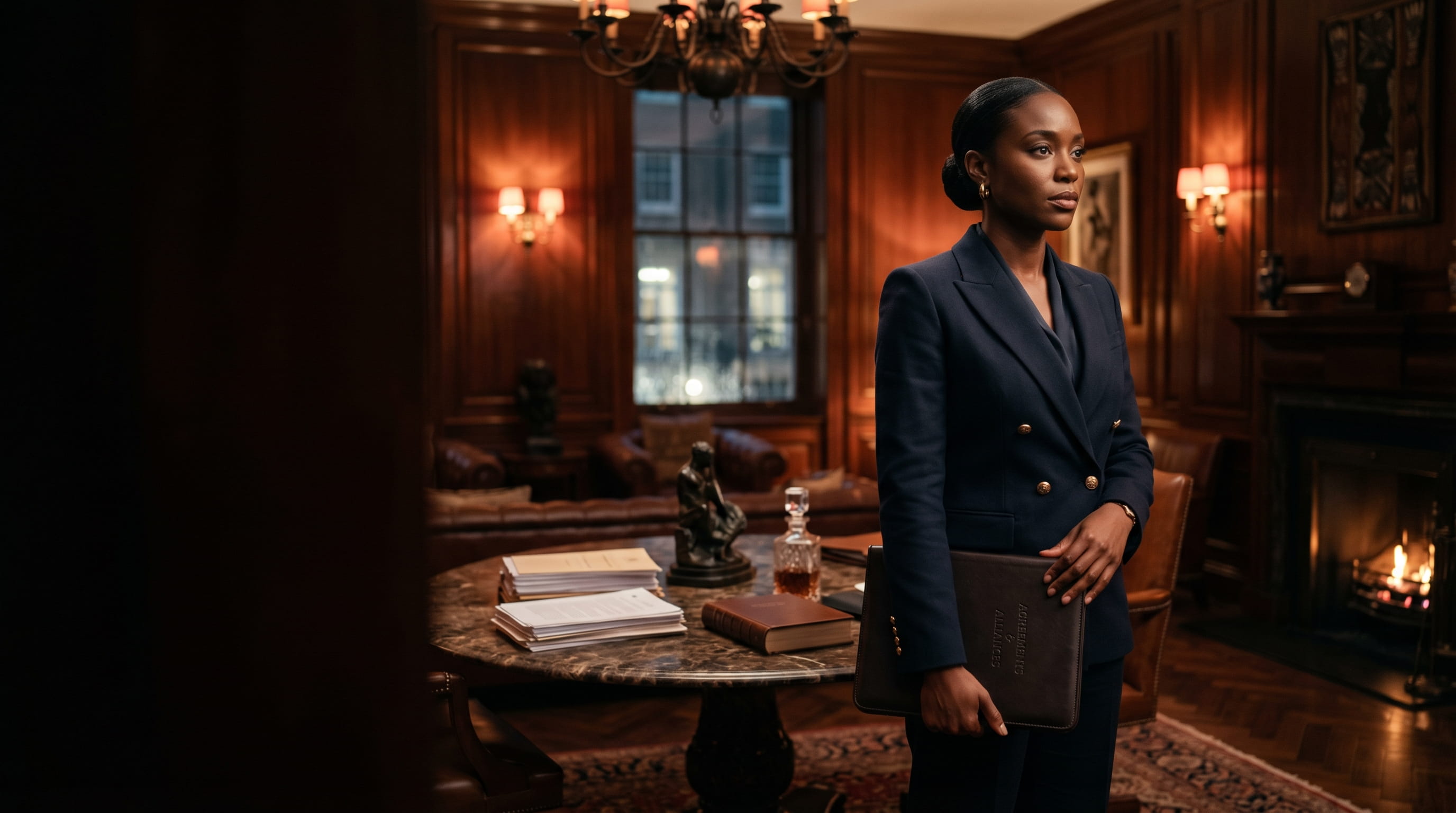
The Whitmore Capital offices were on the thirty-fourth floor of a building in Canary Wharf that expressed opinions about itself through architecture — all glass and deliberate angles, the kind of building that said we do not need to announce our importance because our importance is visible from the Thames.
She wore the grey suit. Not the navy, which was her power suit, the one she wore when she needed the room to take her seriously immediately. The grey, which was more ambiguous, which said I have not decided what this is yet — because she had not, and she was not going to pretend to a position she did not hold.
She wore the Atomic Rose.
She had not decided this consciously. She had stood at her bathroom shelf at seven AM and reached for it without deliberation, which was how she knew it had become a habit already — two days and it was already what she reached for. She noted this and moved on.
The assistant who collected her from reception was young and precise and said nothing beyond what was necessary, which told her something about the culture of the place. She was shown into a meeting room — not Zane Whitmore's office, a meeting room, which was a choice — and she was given water and told he would be a few minutes.
She did not sit.
She stood at the window and looked at the river and she reviewed what she knew and what she did not know and she identified the questions that needed answers before she agreed to anything, because she was not going to agree to anything without understanding the full shape of it.
The door opened.
She turned.
Zane Whitmore was not what the photographs suggested — photographs suggested a man who was put-together in the way that CEOs are put-together, which is managed and deliberate and slightly removed from the body it inhabits. In person he was something different. Tall. The kind of still that was not stillness but control — the stillness of something that was capable of a great deal of movement and was choosing not to. He had his mother's colouring and his father's bearing and eyes that were doing something she could not immediately name, processing her in a way that was not rude but was entirely unhidden.
He did not extend his hand immediately.
Neither did she.
They looked at each other for a moment that was three seconds and felt longer.
"Ms. Osei-Mensah," he said. His voice was mid-Atlantic — New York shaped by Switzerland, smoothed by London. "I was expecting your cousin."
"I know," she said. "You got me instead."
Something shifted at the corner of his mouth. Not a smile — the consideration of one.
"Sit down," he said.
"I will in a moment." She turned back to the window briefly, then back to him. "I want to understand something before we begin. The condition you attached to this partnership — the personal alliance — is it a genuine requirement or a negotiating position?"
He looked at her for a moment.
"Genuine," he said.
"Why?"
"Because I have learned that the partnerships that hold through difficulty are the ones where both parties have given something they cannot easily take back. Capital is easy to take back. People are not."
She considered this. It was, she thought, either the most honest thing a man in his position had ever said to her or the most sophisticated manipulation she had encountered. Possibly both.
"Then we should talk about terms," she said.
She sat down.
The meeting lasted three hours.
She had brought a notepad and she used it — not performatively, actually, the way she used a notepad in every meeting that mattered, because writing things down was how she trusted herself to have heard them correctly. She wrote his terms and she wrote her counter-terms and she wrote the questions she had answered and the ones that remained open.
He watched her write.
At some point in the second hour she noticed that he was watching her hands when she wrote, not in a distracting way — he was still entirely present in the conversation — but with a quality of attention that was adjacent to distraction, a fraction of his focus going somewhere it had not intended.
She did not mention it.
At the end of the third hour they had the outline of an arrangement. Twelve months. A formal engagement announced publicly, marriage at six months if due diligence on the partnership was satisfactory, a private agreement governing the terms of the arrangement and its dissolution. She would retain her career — this was non-negotiable and he had not attempted to negotiate it. He would retain his life — same. They would present as a couple in the contexts that required it and maintain their own lives in the contexts that did not.
"There is one thing I need to know," she said, when they had finished.
"Ask."
"Daniel Osei-Mensah," she said. "My brother. You know him."
The stillness in him changed quality. Not more tense — more deliberate. The stillness of a person choosing a response rather than having one.
"We have met," he said.
"How."
"That," he said, "is a conversation for another time."
She looked at him.
"There will be another time," she said. "I am not asking you for it now. I am telling you it will be asked."
"I know," he said.
He said it the way you say something you have been preparing for — not easily, but with the specific quality of acceptance.
She stood. She picked up her notepad. She extended her hand.
He took it.
His hand was warm and the grip was precise and he held it a half-second longer than handshakes required, not in a way that was forward but in a way that was paying attention, and she noted it and let go and walked to the door.
"Ms. Osei-Mensah," he said.
She turned.
"What is that?" he said. "The perfume."
She looked at him for a moment.
"Mine," she said.
She left.